

The Indian government has clarified that India rejects U.S. pressure to send warships to the Gulf, confirming that no bilateral discussions have taken place with Washington regarding naval deployments in the Strait of Hormuz. This statement from the Ministry of External Affairs (MEA) comes after U.S. President Donald Trump publicly urged nations—including China, France, Japan, and the UK—to deploy military vessels to counter Iran’s “artificial constraint” on the critical waterway. While the U.S. seeks a multilateral military coalition, New Delhi is maintaining its stance of strategic autonomy.
Why India Rejects U.S. Pressure to Send Warships to the Gulf
During a media briefing on Monday, March 16, 2026, MEA spokesperson Randhir Jaiswal addressed whether the U.S. had formally approached India for military cooperation in the region. Jaiswal noted that while India is “aware” of the international discourse surrounding the maritime blockade, New Delhi has “not yet discussed it in a bilateral setting” with the United States.
The refusal to join a foreign-led military force aligns with India’s historical policy. Although the Indian Navy currently operates Operation Sankalp to escort domestic merchant ships, it does so independently rather than as part of a Western-led combat coalition.
Diplomacy Yields Results for Energy Security
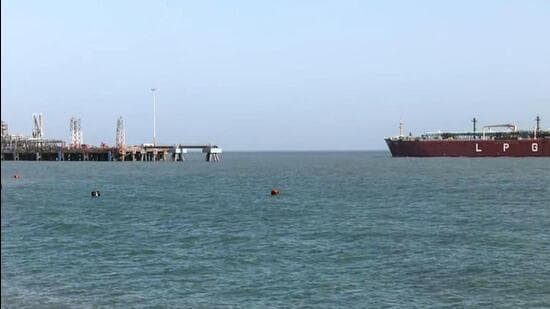
Instead of military escalation, India has leveraged high-level diplomatic channels with Tehran. This strategy bore fruit early Saturday when two Indian-flagged tankers, the Shivalik and Nanda Devi, successfully crossed the Strait of Hormuz. The vessels carried a combined 92,712 metric tonnes of LPG, a vital shipment for India’s domestic energy needs.
This safe passage followed direct telephonic conversations between:
-
Prime Minister Narendra Modi and Iranian President Masoud Pezeshkian.
-
EAM S. Jaishankar and his Iranian counterpart, Seyed Abbas Araghchi.
No “Blanket Arrangement” with Iran
External Affairs Minister S. Jaishankar recently told the Financial Times that while there is no “blanket arrangement” for all Indian ships, ongoing talks with Iran are “yielding results.” Jaiswal reiterated that these diplomatic successes are not based on an “exchange” or quid pro quo, but rather on a long history of engagement between the two nations.
Safety of Indian Seafarers and Energy Concerns
Despite the successful transit of the two LPG carriers, the situation remains tense. Rajesh Kumar Sinha, Special Secretary in the Shipping Ministry, confirmed that 22 Indian-flagged vessels—including crude oil and LNG tankers—remain west of the Strait in the Persian Gulf.
-
Total Seafarers: 611 Indian crew members are currently on these stationary ships.
-
Safety Status: All personnel are reported safe, though there is no confirmed timeline for their return journey.
A Call for De-escalation
India has remained consistent in its official stance on the conflict involving Israel, the U.S., and Iran. Jaiswal highlighted that New Delhi continues to advocate for:
-
Restraint and De-escalation: Moving away from active hostilities.
-
Sovereignty: Respecting the territorial integrity of all states.
-
Dialogue: Utilizing diplomacy over “warships in the Gulf” to resolve the crisis.
As EAM Jaishankar heads to Brussels to meet with European Union counterparts, the security of the Indian diaspora and national energy security will remain at the top of the diplomatic agenda.

Leave a Reply